
Probably about a year ago, in a discord server for fans of a musical, a friend said that if they had a nickel for every transgender friend they had who was named after Meriwether Lewis, they’d have two nickels. I instantly knew I had to get to know this other person.
Part of my experience with being a Lewis and Clark historian has been a certain divorce from historical community. The opportunities for research of the expedition are very limited in Florida, and I had never met anyone with a passion for the expedition before.
I was able to communicate with my new friend, who I will call Other Lewis for the sake of clarity, and we pretty quickly bonded and began planning a trip to the Meriwether Lewis Burial Monument in Hohenwald, Tennessee. Other Lewis has been to the monument upwards of ten times, since it is only a few hours from his home. For me, this was a much more significant roadtrip. If I never stopped driving (but I do often make stops on long roadtrips), it would be an 11 1/2 hour drive from my home in Jacksonville to the monument.
The first time this trip was attempted, disaster struck. I had chosen to go up through Georgia, and was pulled over about 2 hours from my home for a broken taillight. The officer then realized I had a suspended license, which I was not aware of. However, Georgia makes no distinction between driving on a suspended license with or without knowing it was suspended. I was arrested and it was definitely traumatic for me. Everything turned out okay, and the charges were dropped, but it was still terrifying and hard to get through. That was last December, with a court date in March.
But, despite my negative first experience, I was determined to see the monument and share the experience with someone who closely understood my feelings towards Meriwether Lewis, his life, and his death.
This time the trip went pretty smoothly!
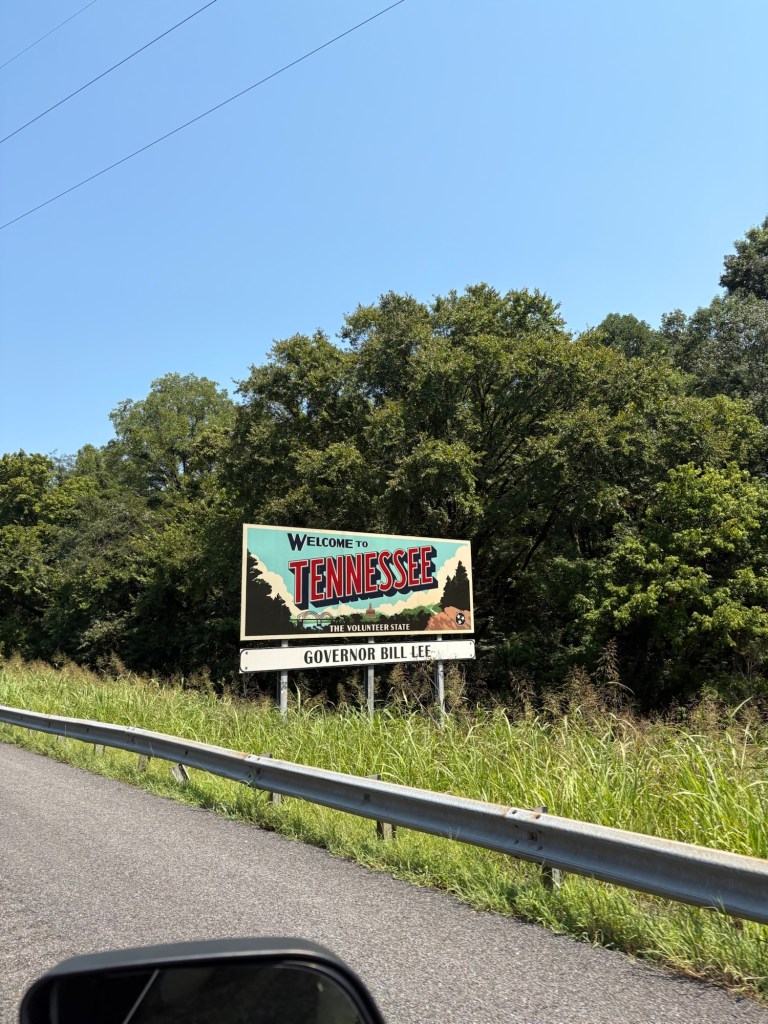
As we drove through Alabama and into Tennessee, I was in awe of the natural beauty of this country. I have always felt a deep connection to outdoor spaces, but I usually just explore my home state of Florida. I haven’t really visited any outdoor attractions outside of the state. I have been on long roadtrips before, I’ve actually even been to Tennessee before once, but I was a child and did not notice my surroundings. It was surreal and breathtaking to witness the overly developed, flat Florida give way to rolling hills and rural environments. I was so struck with the fact that the moment I crossed into AL from FL, I saw much less pavement and much more wild spaces. And the hills! Incredible. Florida is so flat that I was in awe of the Appalachian foothills. I was kind of scared my car wouldn’t make it over them, but we had good luck and never had any issues.
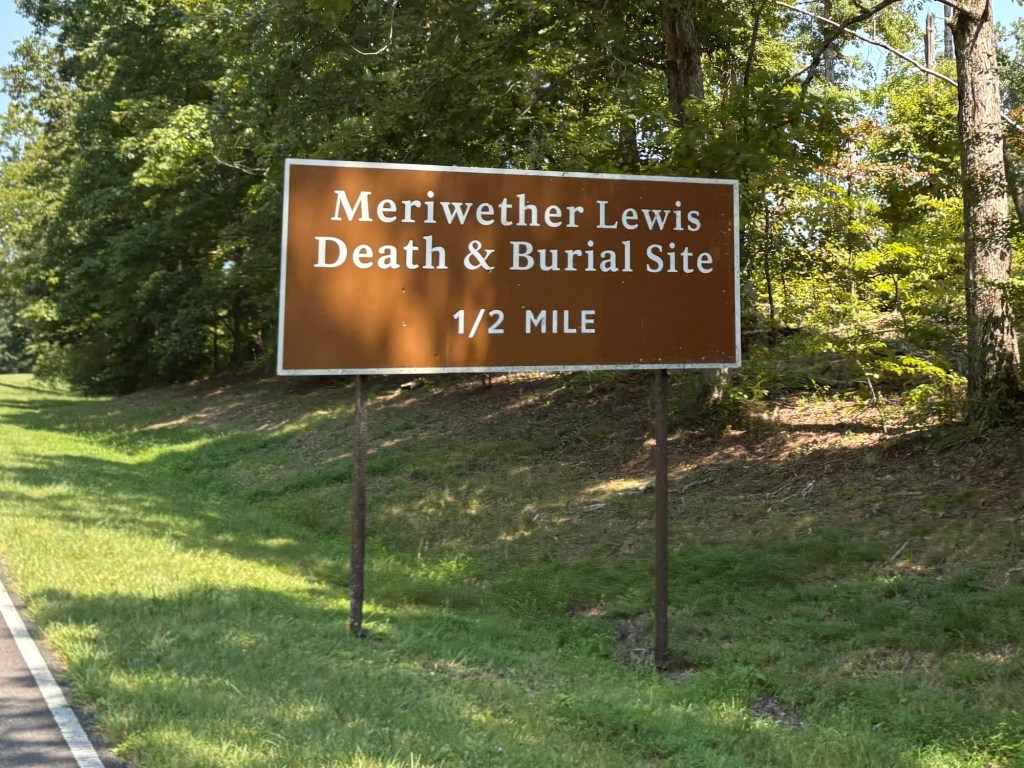
To enter into the Meriwether Lewis Burial Monument, you drive on a small portion of the Natchez Trace. The Natchez Trace is a 444-mile scenic roadway through three states that roughly follows the “Old Natchez Trace”, which was a traveling corridor used by American Indians as well as others in North America. The Natchez Trace has been used for 10,000 years, traveled by American Indians, our first postal workers, and Meriwether Lewis on his way to his death.
Meriwether Lewis had a rough period of life after the Lewis & Clark expedition. After returning to civilian life, he was plagued by alcoholism, mental illness (that had been observed throughout his life and was observed in his father, making it likely hereditary), failure in his capacity as Governor of the Upper Louisiana Territory, failure to prepare his journals for publishing, and rebuke from the War Department. Lewis was traveling the Natchez Trace to visit Washington D.C. to protest the refusal of the War Department to reimburse him for expedition related expenses when he died.
Lewis was traveling with his own servant, a free black man named John Pernia, and was joined by Major James Neelly and Neelly’s enslaved servant when he arrived at a home called Grinder’s Stand on October 10th, 1809.
Grinder’s Stand was a kind of home where one traveling the Trace could stop and pay for lodging for the night. James Neelly did not arrive at Grinder’s Stand with Lewis, instead he was further South. The man of the house, Mr. Grinder, was out. Mrs. Grinder provided Lewis the cabin to stay in, with her and her children remaining in the separate kitchen and the servants taking the stables. In the middle of the night, Mrs. Grinder “heard two gunshots and found Lewis bleeding from his wounds. My sunrise on October 11th, 1809, Lewis was dead.”1
There is much debate over whether or not Meriwether Lewis’ death was a suicide. To credit those who argue it was a suicide, most of Meriwether Lewis’ contemporaries (Jefferson, William Clark, etc.) believed it was suicide, except for his mother. Mothers are a bit inclined to be biased, one can admit. A commission charged to find Meriwether Lewis’ body amongst others buried at the site found it likely based on the body that he was murdered, but we have no record of why they came to this conclusion.
I choose to stick with Jefferson and Clark’s interpretation of Lewis’ death, that “the weight of his mind ha[d] overcome him” and he committed suicide.2 This conclusion is simply more probable given the evidence presented of the death itself, and supported by Lewis’ poor mental health at the time, the creation of his will prior to his death, and previous suicide attempts leading up to his death.
All that being said. The place where this man killed himself means a lot to me.
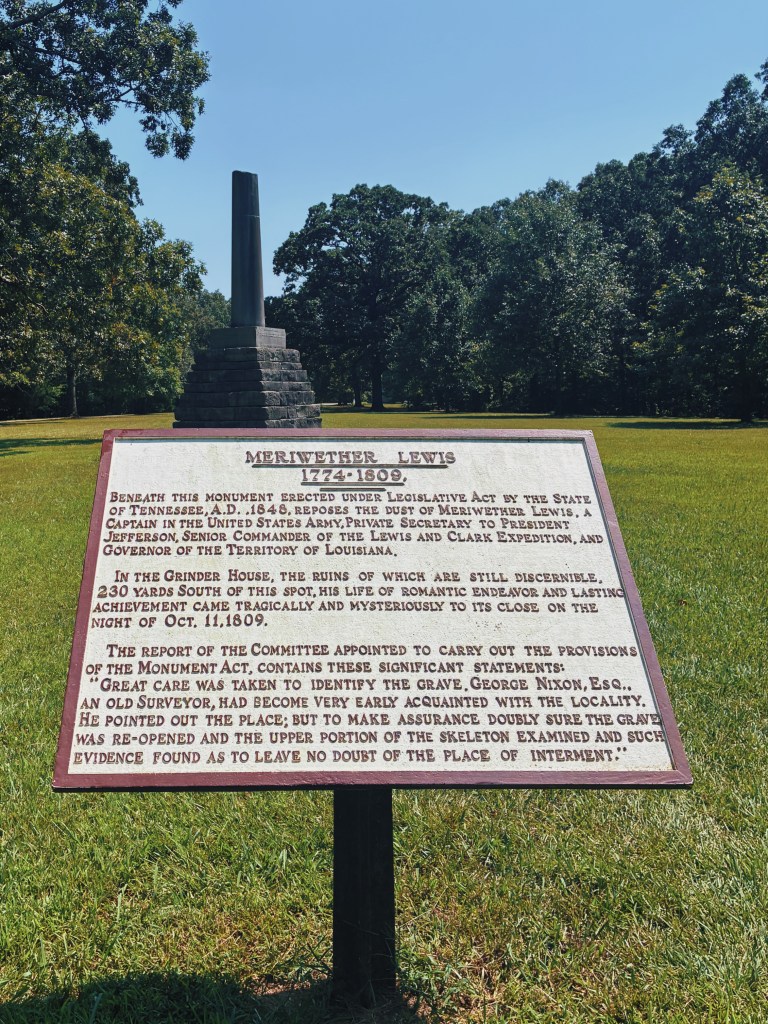
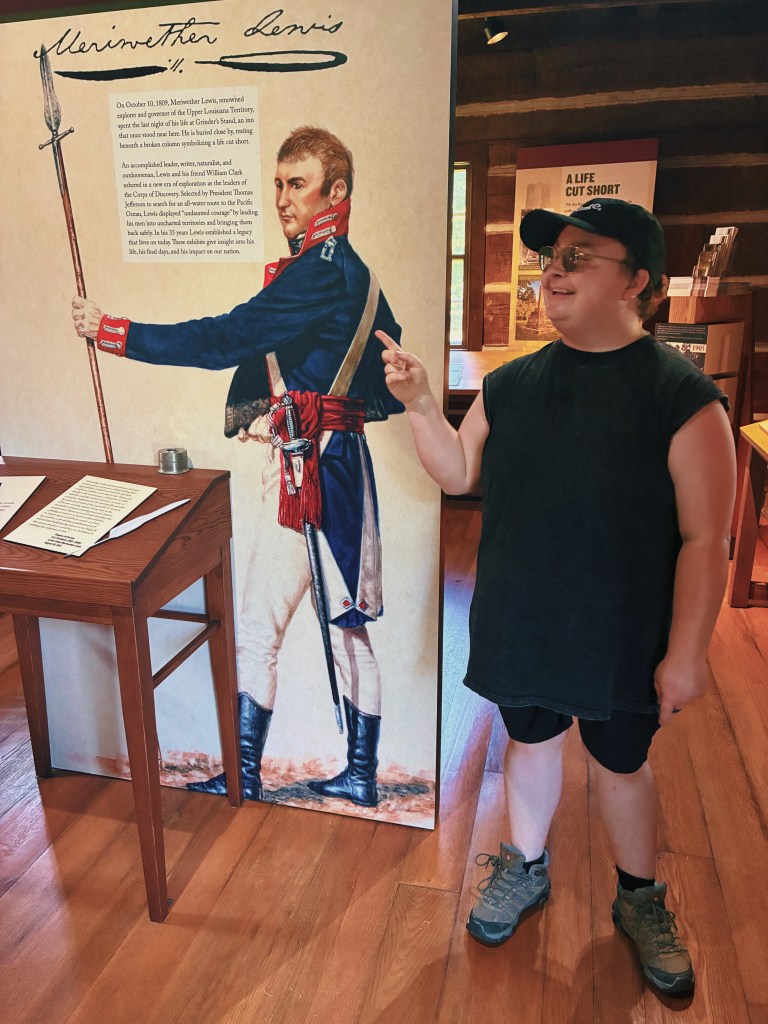
We visited the monument twice on our trip. That first time, I was struck with awe. Awe that this was all real, that this man who I felt so connected to and interested in was real and his remains lay before me. I did not cry, with a bit of difficulty. I was slightly haunted by my own passive suicidal ideation. I wasn’t consciously thinking of killing myself, but the subject matter of the site returned my attention to the idea more than a few times during my visit. We didn’t stay long, just long enough to take a few photos and explore the small visitor center in a cabin on the property. (Note: the cabin is NOT a replica of Grinder’s stand.)
In my first visit to the monument, I think I was blocking a lot of feelings. I joked, and didn’t want to seriously acknowledge the meaning that this visit and space held for me.
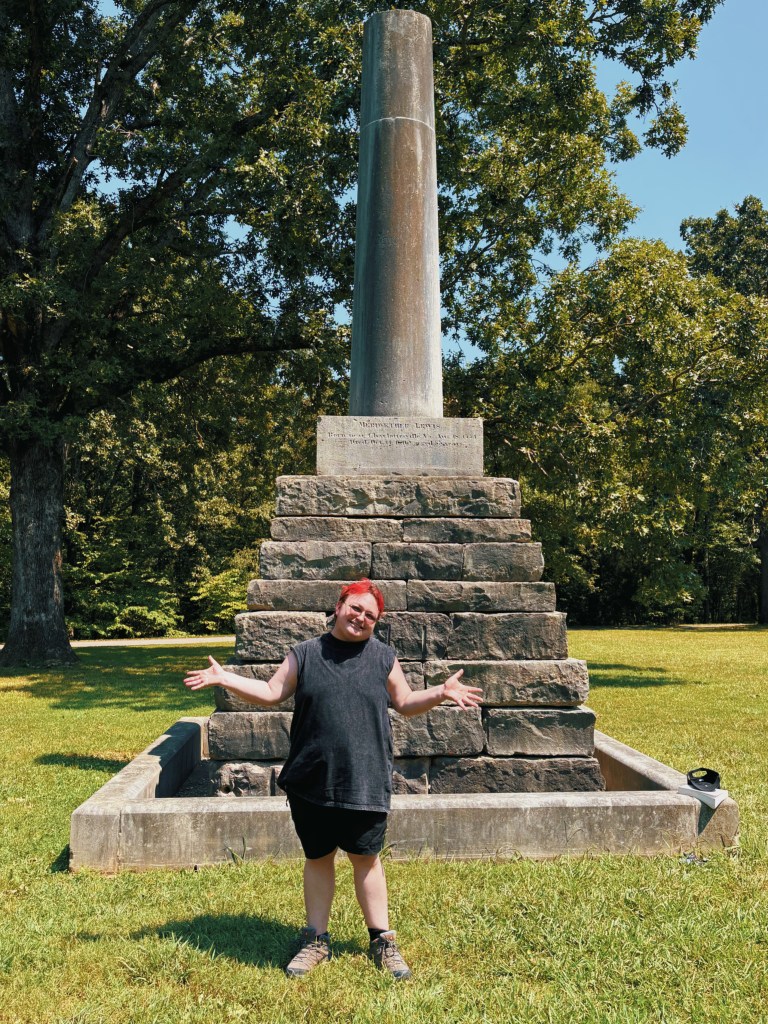
After some dinner and rest, we returned to the monument in the morning of the following day. I requested to sit in silence with the grave for a few moments, which Other Lewis obliged me. I knew I couldn’t leave the site without doing some kind of serious acknowledgment.
I have a weird relationship to spirituality and religion and the afterlife. I sometimes wonder what Meriwether Lewis truly thought of it all, though there are little sources on the subject. I’m inclined to believe he may have shared Thomas Jefferson’s opinion – that there is a loving and intentional creator in God, that we will be reunited with loved ones in the afterlife, that prayer did very little, that miracles were falsehoods, that the resurrection of Jesus Christ did not happen or did not mean what Christians think it does, and that the idea of original sin is a gross injustice.3 These are all things I tend to agree with, too. My thoughts on Meriwether Lewis’ beliefs are a mix of projection and the likely truth that he followed his mentor in many things, why wouldn’t he follow this too?
Anyway. I do not necessarily think that I have any way to contact or commune with Meriwether Lewis’ departed spirit. Even if I could, I think he would probably be happier being left alone. But, even without the belief that it was effective communication to a dead man, I found myself offering up a prayer, of sorts. A promise.
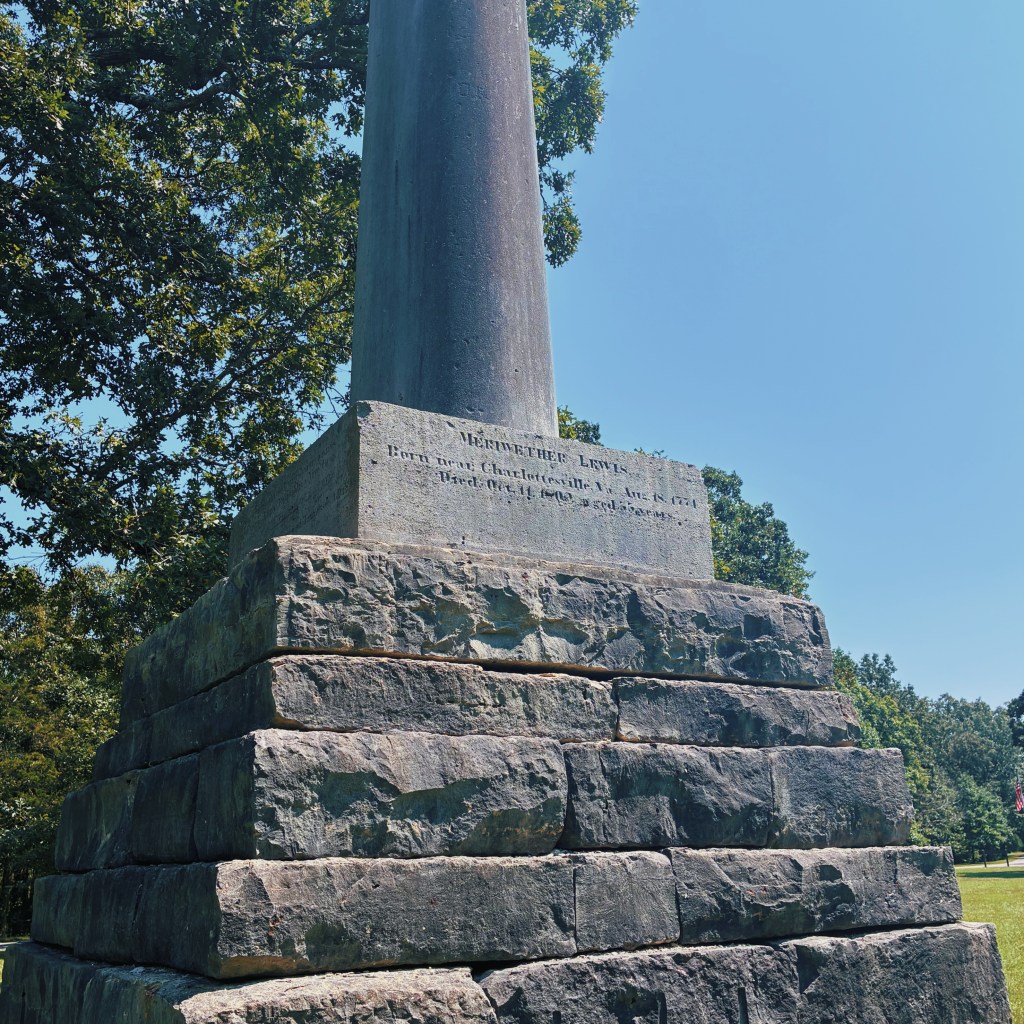
Sitting on his grave, I promised a long dead Meriwether Lewis that I would not kill myself. That I would, in a way, continue what he started. I would dedicate my work to inspiring the nation to explore and appreciate the natural world we have been so blessed with, the world that is partially the fruit of his and his contemporaries’ labors. I also promised to continue telling his story, though I think that one is of less importance to him than the first would be.
Again, I don’t really think he heard this. And it wasn’t a promise I had any plan to make. It’s a promise that came to me as I was sitting on his grave, a promise that I hesitated making, because I have never been able to promise staying alive to anyone I know in reality. But it was something that came to me as I sat with his memorial and his remains. And I had the persistent, nagging feeling to make this promise. So I did. And I intend to keep it, for better or for worse.
Much of Meriwether Lewis’ writing inspires me. I find his waxing poetic about nature endearing and relatable and inspiring. But a passage that has drawn me to him and his mind since the very beginning of my fascination is his birthday meditation from August 18th, 1805. I think I shall include it here, in lieu of closing statements.
”This day I completed my thirty first year, and conceived that I had in all human probability now existed about half the period which I am to remain in this Sublunary world. I reflected that I had as yet done but little, very little indeed, to further the hapiness of the human race, or to advance the information of the succeeding generation. I viewed with regret the many hours I have spent in indolence, and now soarly feel the want of that information which those hours would have given me had they been judiciously expended. but since they are past and cannot be recalled, I dash from me the gloomy thought and resolved in future, to redouble my exertions and at least indeavour to promote those two primary objects of human existance, by giving them the aid of that portion of talents which nature and fortune have bestoed on me; or in future, to live for mankind, as I have heretofore lived for myself.–”4
- National Park Service, “Exploring the Meriwether Lewis Site,”NPS.Gov, September 15, 2022, https://www.nps.gov/natr/learn/historyculture/exploring-the-meriwether-lewis-site.htm ↩︎
- William Clark, letter to Jonathan Clark, October 28, 1809. https://filsonhistorical.omeka.net/items/show/5717 ↩︎
- Thomas Jefferson’s Monticello, “Jefferson’s Religious Beliefs,” Thomas Jefferson Encyclopedia, accessed August 26, 2026, https://www.monticello.org/encyclopedia/jeffersons-religious-beliefs . ↩︎
- Meriwether Lewis in field journal, August 18, 1805. https://lewisandclarkjournals.unl.edu/item/lc.jrn.1805-08-18 ↩︎


Leave a Reply